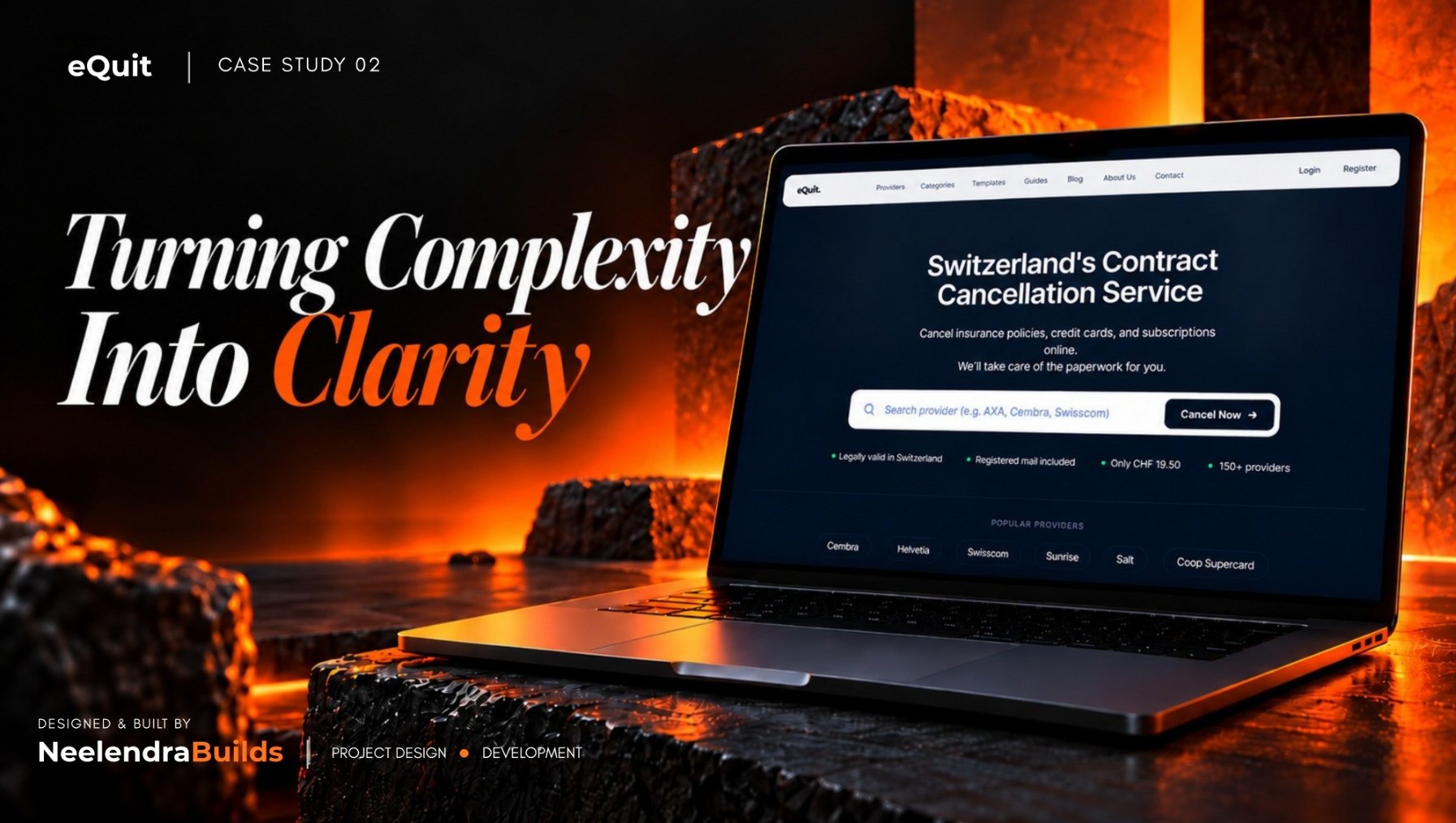
eQuit
Switzerland's contract cancellation platform — built to handle concurrent cancellations, broker workflows, and payments with clarity and control.
We joined eQuit while the platform was struggling at its core. Our work focused on stabilising what mattered most: cancellations, transactions, and the role-based panels that brokers and administrators rely on every day.
Visit Live Site- Role
- Full Stack Developer
- Duration
- 2 months
- Year
- 2026
- Location
- Switzerland
Stack
Overview
eQuit helps people in Switzerland cancel insurance policies, credit cards, and subscriptions without wrestling with the paperwork.
The platform serves three very different audiences — individual customers, brokers who handle cancellations on behalf of clients, and enterprise teams who oversee both — each with its own panel and level of control. It has to run many cancellation requests, broker assignments, and payments at the same time. We were brought in as the development partner to get the core of the product working reliably again.
The Starting Point
The platform was already live, but its foundations had not kept up with it. The backend logic driving cancellations and transactions was broken, so requests could stall or fail without explanation. The frontend had drifted into inconsistency, and there were no proper tools for the people running the business day to day — brokers had no structured panel to track their work, and administrators had little oversight of what was happening on the platform.
In a compliance-sensitive market like Switzerland, an unreliable cancellation is more than a bug; it is a reputational risk. The business was feeling that pressure every day.
Our Approach
- 01
Understanding the existing system
We began by mapping how the platform actually worked — how a cancellation travelled from request to completion, where transactions were recorded, and which parts of the logic were failing. Getting that picture right meant fixing real problems instead of guessing at them.
- 02
Stabilising the core
With the flow mapped, we rebuilt the broken backend logic behind cancellations and transactions, adding the validation and state handling it had been missing so requests moved forward predictably.
- 03
Rebuilding the role-based panels
We developed three distinct panels — Admin, Broker, and Team Manager — so each audience had the tools its role demanded. Brokers could manage their pipelines, administrators could oversee the platform, and teams could work together without friction.
- 04
Integrating payments
We integrated Stripe so payments processed correctly and reliably, closing the gap between a completed cancellation and a recorded transaction.
- 05
Refining the experience
Working in React and Tailwind CSS, we rebuilt key frontend components to bring the interface back to a consistent, modern standard — one design language across every panel.
What We Delivered
01Rebuilt cancellation logic
A re-engineered cancellation engine with proper state management, validation layers, and audit trails, so every action is traceable and reliable.
02Three role-based dashboards
Dedicated Admin, Broker, and Team Manager panels that make the platform a true multi-tenancy system, each tailored to the people using it.
03Stripe payment integration
Secure, reliable payment processing connected directly to the cancellation workflow.
04Consistent frontend system
Key platform components and interface patterns rebuilt for a coherent, modern look across the whole product.
The Outcome
With the core stabilised, eQuit started behaving the way a platform should. Transactions processed correctly, cancellation orders moved through the system without friction, and brokers could work their pipelines confidently. Administrators finally had the oversight they had been missing.
The client regained confidence in the product and began marketing it again. More importantly, the platform now rests on a technical foundation solid enough to scale into new contract categories.
Reflection
eQuit is a reminder that a platform can look finished while its foundations are not. The most valuable work here was rarely the most visible — it was tracing a broken workflow back to its cause and rebuilding it so the business could rely on it. That is the work we enjoy most.